Six German Factories. One Common Thread
- Tony Gunn
- 20 hours ago
- 7 min read

By Tony Gunn | The WorldWide Machinist
Germany doesn't manufacture. Germany obsesses.
I just wrapped up one of the most intense weeks of factory tours I've done in a long time. Six stops. Back-to-back. Across some of the most serious precision manufacturing facilities on the planet — all as part of Jan Votteler's German tour.
Every shop had a different specialty. Every team had a different story. But by the time I walked out of the last one, I realized they were all telling the same story — just in different dialects.
And running through every single stop, like a red thread stitched into the spine of German engineering, was one name: *Rego-Fix powRgrip.*
Let me take you through it.
Stop 1 — Chiron Group: When Speed Becomes a Philosophy



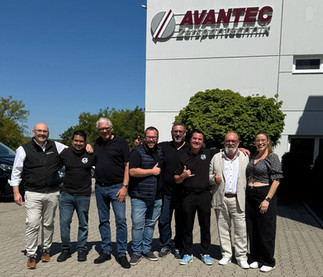


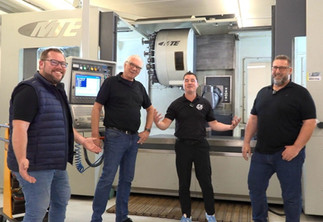


They say "time is money." At the Chiron Group headquarters in Germany, they didn't just say it — they engineered their entire existence around it.
Chiron builds the world's fastest tool changer. Walking that production floor reset my definition of fast. When you build machines this quick, you're giving shop owners the ability to cut harder materials, tackle more complex geometries, and pivot between automotive and medical in the same shift. That's not a feature list — that's a competitive edge measured in seconds per cycle, multiplied across thousands of parts.
But here's what nobody talks about.
When a machine is pushing those cycle times, the toolholding has to be flawless. The G-forces alone will expose every weakness in the chain. That's why Chiron runs with Rego-Fix. You can have the fastest spindle on the planet — but if the toolholding isn't rock-solid, that speed is wasted. Every micron of runout at high RPM is a liability, not a rounding error.
Seeing their precision products integrated directly into these machines was a reminder I kept coming back to all week: manufacturing is a chain. If one link isn't perfect, the entire output suffers.
Stop 2 — AVANTEC Zerspantechnik: They Don't Tiptoe Around Titanium











Machining Titanium is a special kind of punishment.
Most materials are happy to be cut. Titanium is stubborn, abrasive, and the metallurgical equivalent of a teenager refusing to do its chores. Most shops treat it like a fragile glass vase — tiptoe around it, feed it slow, and hope the spindle survives in a fit of rage.
Then there's AVANTEC Zerspantechnik.
At Avantec, it's about performance with an attitude. They're setting records because they genuinely refuse to play by the rules of the industry handbook. When the handbook says "don't push the tool that hard," Avantec looks at the handbook, uses it to level a wobbly workbench, and pushes harder anyway.
Avantec provides the teeth to bite into the material. The Rego-Fix powRgrip system provides the jaw strength.
If your toolholder is vibrating — if it's got even a micron of runout, if the grip isn't absolute — the hard material wins. Every time. Budget holders lose their grip under thermal load and centrifugal force. Rego-Fix stays locked in. When you're titanium busting at this level, there is absolutely no room for a weak link in the chain.
Stop 3 — Mitsubishi Materials Tools Europe + Open Mind Technologies: The Barrel Machining Deep Dive



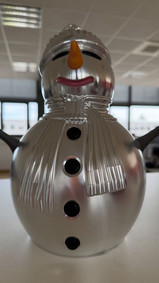


Mitsubishi Materials Tools Europe was a stop I'll soon not forget.
We dove head-first into the science of *Barrel Machining* alongside the geniuses at Open Mind Technologies — and this one genuinely surprised me. For those not deep in the weeds of high-end 5-axis work: Barrel Machining is arguably the biggest leap in surface finishing efficiency of the last decade. Instead of crawling across a surface with a ball-nose cutter in tiny incremental steps, you use the massive radius of a barrel cutter to get dramatically better finishes in a fraction of the time.
Knowing the technology exists and actually mastering it are two very different things. That's exactly where Mitsubishi Materials earns its reputation. Seeing their R&D lab and their approach to customer support was — as I called it in the moment — a wake-up awesome. They're helping shops engineer their way out of old-school limitations, and they back it up with the kind of technical depth you can only get from people who live and breathe this stuff.
But what makes advanced strategies like barrel machining actually survive real-world conditions? The Rego-Fix Group precision interface. That partnership is what ensures these cutting strategies hold up under the G-forces of modern machining. You can engineer the most brilliant cutting path in hyperMILL — it means nothing if the interface between tool and spindle can't handle the load.
Stop 4 — Zecha Hartmetall-Werkzeugfabrikation: Precision as a Personality Disorder



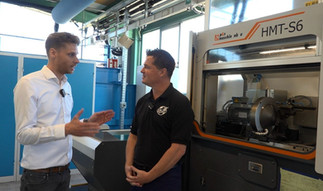




If you walk into a machine shop and see a tool so small it looks like a splinter from a fairy's tooth — chances are it has the Zecha name on it.
Since the 1960s, Zecha Hartmetall-Werkzeugfabrikation has been treating precision as a personality disorder. Now in its third generation of family ownership, they've turned the "Made in Germany" label into a polite understatement.
Their roots are in the chronograph industry — when your origin story involves making watch components where a stray sneeze ruins a week's work, you develop a certain... intensity. They've carried that watchmaker's soul straight into the world of hard metal. Every single tool is laser-etched with a lifetime identification number — basically a Social Security number for an end mill. Buy a Zecha tool today and another one five years from now — the reproducibility is so identical it's spooky.
They've moved into micro-slitting cutters only 0.02 mm wide. To put that in perspective: if you tried to cut a piece of paper with that, the paper would feel like a giant redwood tree. At those diameters, even a microscopic amount of runout acts like a sledgehammer — snapping carbide before it even touches the workpiece.
This is why the partnership between Zecha and Rego-Fix Group is less of a business deal and more of a Power Couple of the micro-machining world. Zecha brings the cutting edge. Rego-Fix brings the powRgrip system. Together, they make the impossible repeatable.
Stop 5 — Diamond Tooling Systems (DTS): They Chose Violence. Via Photons.









Back in 2009, while the rest of the world was figuring out how to survive the financial crisis, Diamond Tooling Systems was born in Kaiserslautern, Germany, with one genuinely crazy idea:
What if we just stop grinding and sparking things into submission and use lasers instead?
For decades, shaping ultra-hard materials like PCD, CVD-D, or CBN meant two choices — grinding or EDM. Grinding is slow, expensive, and about as flexible as a brick. EDM is accurate but only works if your material plays nice with electricity.
DTS entered the chat and chose violence. Via photons.
Their laser ablation doesn't care about conductivity or grindability. If it exists on the Mohs scale, DTS can slice it like a warm brie. But cutting a diamond with a laser means nothing if your toolholder has the stability of a Jenga tower — you're just making expensive scrap.
That's where Rego-Fix comes in. DTS provides the sharpest, laser-honed edges known to man. Rego-Fix powRgrip provides the holding power — the Hulk's grip of the machining world. The sharpest edges on earth deserve the most thermally stable, consistent grip available. That's exactly what they get.
Stop 6 — Lang Technik GmbH: Innovation as a Contact Sport

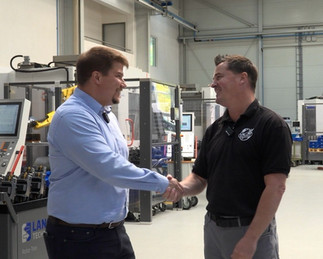


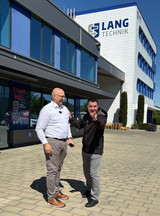





Last stop. And the right note to end on.
Some companies treat innovation like a buzzword they found in a fortune cookie. Lang Technik GmbH treats it like a contact sport.
Before Lang, changing a setup was a marathon — sweeping vises, praying to the gods of indicators, burning 45 minutes on a task that should take 45 seconds. After Lang? It's a pit stop. The Quick•Point® system lets you swap vises, fixtures, or entire automation pallets with a repeatability of < 0.005 mm. That's not impressive — that's embarrassing to every other workholding solution on the market.
Then there's the Makro•Grip®. Most vises hold a part like a nervous toddler holding a frog — too much pressure and you deform it, too little and it leaps away at 10,000 RPM. The Makro•Grip® pre-stamps a serration into the material with 20 tons of force, so the vise only needs a "handshake" of pressure to hold with bank-vault security.
Here's what I love most: to manufacture those legendary Lang vises to that standard, Lang themselves rely on the Rego-Fix powRgrip system for the thermal stability and runout accuracy the job demands. The people who make world-class workholding use world-class toolholding to build it. The circle is complete.
If your shop is still spending 45 minutes indicating a vise, you're not old school. You're just donating money to the scrap bin.
The Thread That Held It All Together
Six companies. Six different specialties.
Chiron with the world's fastest tool changer. Avantec breaking titanium records. Mitsubishi Materials and Open Mind mastering barrel machining. Zecha crafting tools that defy comprehension. DTS carving diamonds with light. Lang reinventing how the world holds its work.
One thread running through all of them.
You can engineer the most remarkable cutting technology, the fastest machine, the most precise tool on earth — and it all falls apart if the interface between tool and machine isn't locked in. Rego-Fix powRgrip kept showing up at every stop — not because it was on a marketing poster, but because at the level these companies operate, there is no room for compromise in the handshake.
Manufacturing is a chain. Every link matters. And when the world's most obsessive engineers decide which link they trust to hold everything together — they keep choosing the same one.
---
*Full factory tours are dropping soon on The WorldWide Machinist channels.*
Subscribe, follow, and stay close — these ones are going to change how you think about your shop floor.
---
Comments